
LMS Buyer's Guide
Best LMS for Corporate Training in 2026
Enterprise-grade learning management systems for corporate training. Compare top LMS platforms for compliance, onboarding, and professional development.
Last Updated: September 2026
Corporate training encompasses the full spectrum of learning and development within large organizations — from mandatory compliance and regulatory training to leadership development, technical upskilling, and soft skills programs. The corporate training market is valued at over $370 billion globally, reflecting how seriously enterprises take workforce development. Yet despite this investment, many organizations still struggle with fragmented training systems, low completion rates, and an inability to connect learning outcomes to business results. A modern corporate LMS consolidates all training into a single platform, providing L&D leaders with the visibility and control they need. Enterprise organizations face unique challenges: training must reach tens of thousands of employees across multiple departments, locations, and time zones. Content must be assigned by role, tracked for compliance, and reported on for leadership. The platform must integrate with existing HRIS, identity providers, and communication tools. And it must do all of this while providing a learning experience that employees actually want to use — because even mandatory training benefits from an engaging, modern interface that respects learners' time.
Who Needs This?
Chief Learning Officer
Multiple disconnected training tools across the organization make it impossible to get a unified view of workforce readiness
A single platform consolidating all corporate training with enterprise analytics and cross-departmental reporting
Enterprise L&D Director
Per-user licensing costs are consuming 60% of the training budget, leaving little for actual content development
Flat-rate pricing frees up budget for content creation and instructional design rather than platform fees
IT Security Manager
Training platforms must meet SOC 2, SSO, and data residency requirements before procurement approval
Enterprise-grade security with SSO integration, role-based access controls, and audit-ready compliance documentation
Key Challenges
Multi-Department Training
Different departments need different content, permissions, and reporting. A one-size-fits-all approach doesn't work.
Compliance Requirements
Regulated industries need audit-ready records, mandatory training paths, and automated recertification reminders.
Measuring ROI
Without tying training metrics to business outcomes, L&D is seen as a cost center rather than a growth driver.
Must-Have Features to Look For
Why Arythmatic Is the Best Choice
Arythmatic is a modern, all-in-one learning infrastructure platform. Here's why it leads the pack:
- 1.Multi-tenant architecture for department-level separation and reporting
- 2.Native live sessions for instructor-led training without Zoom add-ons
- 3.Built-in compliance tracking with certificate automation
- 4.Modern UI that employees actually want to use
- 5.All-in-one platform eliminating tool fragmentation
Compare Top Platforms
| Platform | Live Sessions | White-Label | SCORM | Community | Pricing |
|---|---|---|---|---|---|
| Arythmatic | ✓ | ✓ | ✓ | ✓ | From $49/mo |
| Thinkific | ✗ | ✗ | ✗ | ✓ | $36–49/mo |
| Teachable | ✗ | ✗ | ✗ | ✗ | $29–39/mo |
| Kajabi | ✗ | ✓ | ✗ | ✓ | $149–399/mo |
| Podia | ✗ | ✗ | ✗ | ✓ | $33–39/mo |
| LearnWorlds | ✗ | ✓ | ✓ | ✓ | $24–29/mo |
| FreshLearn | ✗ | ✗ | ✗ | ✓ | $29–49/mo |
How to Evaluate LMS Platforms for This Use Case
Typical Implementation Timeline
Enterprise Planning
Stakeholder alignment, SSO configuration, organizational hierarchy mapping, and role-based access control setup.
Content Migration & Build
Migrate existing SCORM content, build new native courses, and configure automated learning paths by department and role.
Pilot Program
Launch with 2-3 pilot departments, gather admin and learner feedback, refine workflows and reporting dashboards.
Enterprise Rollout
Phased rollout across all departments with change management communications, manager training, and full analytics activation.
What Does an LMS Cost?
Enterprise corporate training platforms range from $10,000 to $200,000+ annually depending on user count, features, and support levels. Per-user pricing at the enterprise level typically runs $5-15 per user per month, meaning a 5,000-employee organization pays $300,000-900,000 annually on licensing alone. Arythmatic's flat-rate model provides dramatic savings at enterprise scale, including unlimited users, full feature access, and multi-tenant capabilities. Implementation costs are also lower since Arythmatic requires no custom development or lengthy professional services engagements.
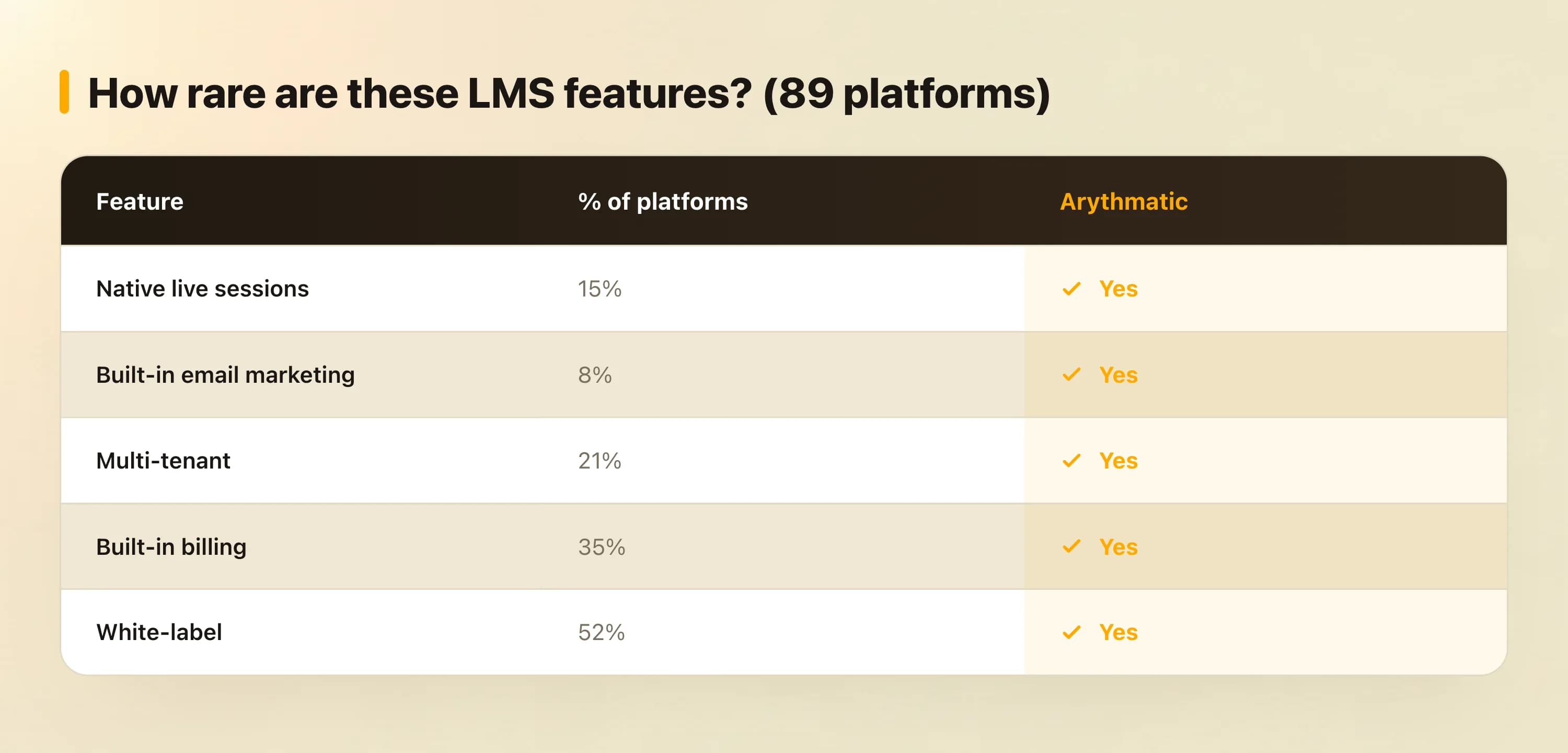
How rare are these LMS features?
Frequently Asked Questions
What features should a corporate training LMS have?
A corporate training LMS should include SCORM support, compliance tracking, role-based access, analytics dashboards, SSO, and assessment tools. Arythmatic includes all of these plus native live sessions and community.
How much does a corporate LMS cost?
Corporate LMS pricing ranges from $2-10/user/month for basic tools to custom enterprise pricing. Arythmatic offers flat-rate pricing starting at $49/month with unlimited courses.
What makes a corporate LMS different from a basic training tool?
Corporate LMS platforms offer enterprise features like SSO, multi-department management, compliance tracking, role-based assignments, and advanced analytics. Arythmatic provides all of these at flat-rate pricing.
How do enterprises measure training effectiveness?
Track completion rates, assessment scores, time-to-competency, and business impact metrics. Arythmatic's analytics correlate training data with organizational outcomes.
Can Arythmatic handle 10,000+ employees?
Yes. Arythmatic's architecture scales to support organizations of any size with unlimited users on flat-rate plans.
Does Arythmatic support instructor-led training?
Yes. Native live session capabilities eliminate the need for separate video conferencing tools for instructor-led corporate training.
How does Arythmatic integrate with existing HR systems?
Arythmatic offers API and webhook integrations for connecting with HRIS, payroll, and identity management systems for automated user provisioning and data sync.
Keep researching
Definitions, alternative platforms, and feature deep-dives relevant to your decision.
Glossary
Learning Management System (LMS)
Glossary
Learning Experience Platform (LXP)
Glossary
SCORM (Sharable Content Object Reference Model)
Glossary
Competency-Based Learning
Buyer guide
Best LMS for Employee Training
Buyer guide
Best LMS for Customer Education & Training
Buyer guide
Best LMS for Compliance Training
Buyer guide
Best LMS Platform for Course Creators
Compare
Thinkific alternatives
Compare
Teachable alternatives
Compare
Kajabi alternatives
Compare
TalentLMS alternatives
Compare
Docebo alternatives
Feature
Course Builder — Create Professional Online Courses
Feature
Live Classes Platform — Host Webinars, Workshops & Virtual Classrooms
Feature
Compliance Training Software — Automate Mandatory Training Programs
Feature
LMS Analytics & Reporting — Data-Driven Learning Insights
Ready to build your academy?
Start your 14-day free trial. No credit card required.