
Original Research · 89 platforms analyzed
The 2026 LMS Feature & Pricing Index
An original analysis of 89 learning management platforms: how common each feature actually is, what transaction fees and free trials look like across the market, and where the category is consolidating. First-party benchmark data.
Last Updated: October 2026
Key Findings
- 15%
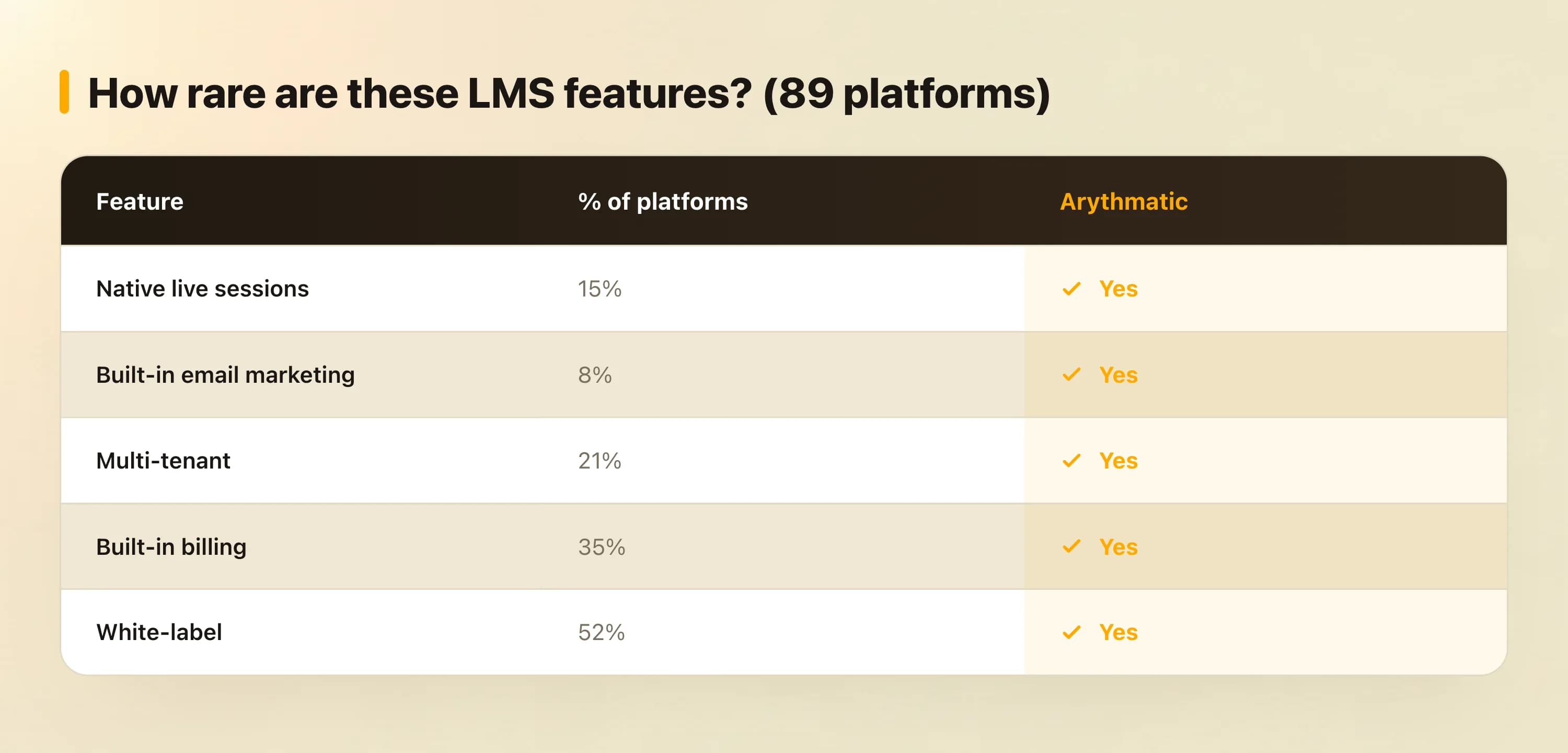
Only 15% of LMS platforms offer native live sessions. The other 85% require integrating Zoom or a separate video tool for live training — a fragmented experience that breaks attendance tracking and recordings.
- 8%
Just 8% include built-in email marketing. The vast majority depend on external tools like Mailchimp or ConvertKit for learner communication and drip campaigns.
- 60%
60% of LMS platforms offer no free trial, gating evaluation behind a sales call or demo request. Among the 40% that do offer a trial, 14 days is the clear standard.
- 21%
Only 21% support multi-tenant architecture — the ability to run multiple separate academies or client portals from one account. This remains a premium, enterprise-tier capability across the market.
- 35%
Only 35% include built-in billing. Platforms that let organizations sell courses or subscriptions natively — without bolting on Stripe and a checkout plugin — are still a minority.
- 57%
SCORM support is present in 57% of platforms — a reminder that the 22-year-old standard remains a baseline requirement, especially in regulated industries, but is far from universal.
How Common Is Each LMS Feature?
Share of 89 platforms that support each capability. The headline features every vendor advertises (analytics, API, course builder) are near-universal — but the features that actually differentiate platforms (live sessions, billing, multi-tenant, email) are surprisingly rare.
The Free-Trial Gap
60% of platforms offer no free trial at all — you must book a demo or talk to sales to evaluate. Among the 40% that do, the 14 days trial is the clear standard.
Transaction Fees
Most LMS platforms (64 of 89) don't process course sales at all — they're corporate training systems where billing is handled elsewhere. But among the 25 platforms that let creators sell courses directly, 24% charge a transaction fee on top of the subscription — models ranging from a flat per-sale fee to revenue shares as high as 50–75%.
For anyone selling courses, that fee is the single most under-scrutinized cost in LMS procurement: a 5–10% cut compounds into far more than the subscription over time. The LMS cost calculator models this explicitly.
The Market by Segment
The 89 platforms analyzed, by primary segment. Corporate/SMB LMS platforms dominate the tracked set, followed by course-creator platforms.
Methodology
This index is computed from Arythmatic's structured dataset of 89 learning management platforms spanning corporate, creator, academic, LXP, community, and marketplace segments. For each platform we record the presence or absence of 14 features, the transaction-fee model, free-trial availability and length, and market segment. Feature percentages are the share of all 89 platforms supporting each capability. The dataset is maintained for our alternatives and comparison research and reflects publicly available product information as of May 2026. Figures are recomputed when the dataset changes materially.
Citation: Arythmatic, “The 2026 LMS Feature & Pricing Index” (2026-05-29). Available at https://arythmatic.cloud/research/lms-feature-index-2026. Free to cite with attribution and a link.
See where Arythmatic lands on every metric
Native live sessions, white-label, multi-tenant, SCORM, and built-in billing — the features most platforms lack. 14-day free trial, no sales call.