
Academic / Open-Source LMS
Top 5 Sakai Alternatives in 2026
Sakai is an open-source learning management system developed by a consortium of universities for higher education teaching and collaboration. Looking for something better? Here are the top alternatives.
Last Updated: September 2026
Top 5 Alternatives to Sakai at a Glance
Quick comparison of the leading Sakai alternatives for course creators, training organizations, and educators.
Arythmatic
From $49/mo · 0% transaction feesPremium learning infrastructure with native live sessions, SCORM/xAPI, white-label branding, multi-tenant architecture, and zero transaction fees — features Sakai typically does not offer at any plan tier.
See Arythmatic pricing →Moodle
Free (self-hosted) / $120+/yr (MoodleCloud)Academic / open-source LMS — different cost structure and customisation depth.
Moodle alternatives →Canvas LMS
Custom (institutional)Academic / open-source LMS — different cost structure and customisation depth.
Canvas LMS alternatives →Blackboard Learn
Custom (institutional)Academic / open-source LMS — different cost structure and customisation depth.
Blackboard Learn alternatives →D2L Brightspace
Custom (institutional)Academic / open-source LMS — different cost structure and customisation depth.
D2L Brightspace alternatives →What Is Sakai?
Sakai is an open-source learning management system originally developed in 2004 by a consortium of universities including the University of Michigan, Indiana University, MIT, and Stanford. The platform was designed for higher education institutions wanting a community-driven alternative to commercial LMS vendors. Sakai provides course management, gradebook, discussion forums, assignment submissions, and assessment tools. While it served as an important alternative during the early days of academic LMS platforms, Sakai has lost significant market share to Canvas and Moodle. The community has shrunk, development pace has slowed, and the interface feels dated by modern standards.
Sakai: Honest Pros and Cons
What Sakai Does Well
- ✓Free and open-source with no licensing fees for self-hosted deployments
- ✓Strong academic features including gradebook, assignment submissions, and discussion forums
- ✓SCORM-compliant for importing eLearning content packages
Where Sakai Falls Short
- ✗Requires self-hosting with server management, security, and maintenance burden
- ✗Dated interface that lags behind modern LMS platforms in usability
- ✗Shrinking community with slower development and fewer plugins than Moodle
- ✗Not suitable for corporate training, course monetization, or external audiences
Why Users Look for Sakai Alternatives
- ●Requires self-hosting and maintenance
- ●Smaller community than Moodle
- ●Dated interface
- ●No commercial support options
- ●Not suitable for corporate training
#1 Alternative: Arythmatic
Arythmatic is a modern, all-in-one learning infrastructure platform that gives you everything Sakai offers — and more. Native live sessions, white-label branding, multi-tenant architecture, and 0% transaction fees.
Where Arythmatic Wins
Native Live Sessions
Built-in live classes, webinars, and meetings — no Zoom or third-party tool needed
Sakai: Sakai requires connecting external video conferencing tools
Multi-Tenant Architecture
Run multiple academies or client portals from a single dashboard
Sakai: Sakai supports only a single academy instance per account
Built-in Billing
Automated invoicing, subscriptions, and payment collection built into the platform
Sakai: Sakai relies on manual invoicing or external payment processors
Email Marketing
Built-in email campaigns, drip sequences, and learner engagement automation
Sakai: Sakai requires integration with Mailchimp, ConvertKit, or similar tools
Certifications
Automated certificate generation with custom templates and expiration tracking
Sakai: Sakai has no built-in certification or credentialing engine
Feature-by-Feature Comparison
| Feature | Arythmatic | Sakai |
|---|---|---|
| Course Builder | ✓ | ✓ |
| Native Live Sessions | ✓ | ✗ |
| Quiz & Assessments | ✓ | ✓ |
| Community Building | ✓ | ✓ |
| White-Label Branding | ✓ | ✓ |
| SCORM/xAPI Support | ✓ | ✓ |
| Email Marketing | ✓ | ✗ |
| Website Builder | ✓ | ✗ |
| Mobile App | ✓ | ✗ |
| Analytics & Reporting | ✓ | ✓ |
| Multi-Tenant | ✓ | ✗ |
| Built-in Billing | ✓ | ✗ |
| API Access | ✓ | ✓ |
| Certifications | ✓ | ✗ |
| Pricing | From $49/mo | Free (self-hosted) |
| Transaction Fees | 0% | N/A |
See the full side-by-side breakdown
Arythmatic vs Sakai — feature by feature
Total Cost of Ownership: Sakai vs Arythmatic
While Sakai is free to download, self-hosting costs include servers ($200-2,000+/month), IT staff time for maintenance and updates, and potential consulting for customization. The true annual cost often exceeds $10,000-50,000 depending on scale. Arythmatic at $49/month provides a managed, modern LMS with no infrastructure burden, often at a fraction of Sakai's real operational cost.
How to Migrate from Sakai to Arythmatic
Switching platforms does not have to be painful. Here is the step-by-step process for moving from Sakai to Arythmatic.
Sakai self-hosted deployment takes 2-4 weeks with IT involvement; migrating from Sakai to Arythmatic takes approximately 1-2 weeks for content and data transfer.
Other Academic / Open-Source LMS Alternatives
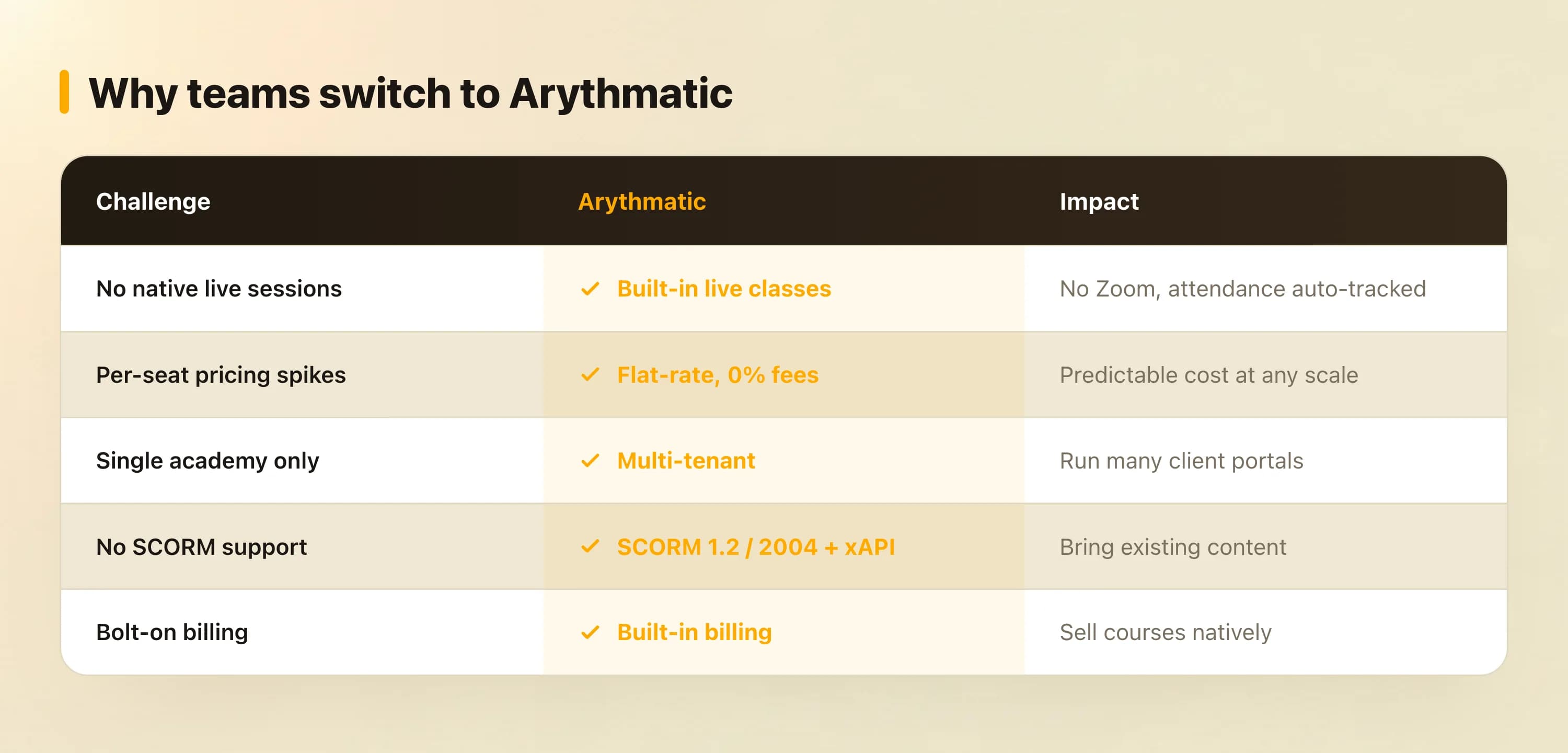
Why teams switch to Arythmatic
Frequently Asked Questions
Is Arythmatic a better alternative to Sakai for growing teams?
Yes. Arythmatic offers everything Sakai provides plus native live sessions, white-label branding, multi-tenant architecture, and 0% transaction fees — making it a stronger choice for organizations that want a complete learning platform.
What is Sakai best suited for?
Universities wanting an open-source alternative to Moodle
How does Arythmatic pricing compare to Sakai?
Arythmatic starts at $49/month with 0% transaction fees and all features included. Sakai is priced at Free (self-hosted).
How do I migrate my courses and learners from Sakai to Arythmatic?
Yes. Arythmatic's support team can help you migrate your content, learners, and data from Sakai. SCORM-compliant content can be imported directly.
More on academic / open-source lms platforms
Continue exploring the academic / open-source lms category — concepts, buyer guides, and feature deep-dives.
Glossary
Learning Management System (LMS)
Glossary
eLearning
Glossary
SCORM (Sharable Content Object Reference Model)
Glossary
Instructional Design
Buyer guide
Best LMS for Higher Education & Universities
Buyer guide
Best LMS for K-12 Schools and Districts
Feature
Course Builder — Create Professional Online Courses
Feature
Quiz Builder — Assessments That Actually Measure Learning
Feature
Live Classes Platform — Host Webinars, Workshops & Virtual Classrooms
Switch from Sakai to Arythmatic
Start your 14-day free trial. No credit card required. We'll help you migrate.