
LMS Buyer's Guide
Best LMS for K-12 Schools and Districts in 2026
Engaging, teacher-friendly learning management systems for K-12 education. Simplify classroom management and student engagement.
Last Updated: September 2026
K-12 education technology has evolved rapidly, with schools and districts needing platforms that support both classroom instruction and remote learning. The pandemic permanently changed expectations for digital learning in K-12, with parents, students, and educators now expecting robust online capabilities as a standard part of the educational experience. K-12 LMS platforms must be age-appropriate, accessible, and simple enough for younger students to navigate independently while providing teachers and administrators with the tools to manage curriculum, track progress, and communicate with parents. The K-12 context creates unique requirements: content must be organized by grade level and subject, assessments must be appropriate for different developmental stages, and parental visibility into student progress is essential. Districts also need to manage training for teachers and staff alongside student instruction, often on the same platform. Security and privacy requirements are strict — COPPA compliance for students under 13 and FERPA compliance for educational records are non-negotiable. The ideal K-12 platform balances educational effectiveness with the practical realities of managing technology across schools with varying levels of technical infrastructure and teacher technology comfort.
Who Needs This?
District Technology Director
Managing multiple learning tools across schools creates IT overhead, security risks, and inconsistent student experiences
Unified platform serving all schools in the district with centralized management and consistent security controls
School Principal
Teachers have varying levels of technology comfort and resist complex platforms that require extensive training
Intuitive interface that teachers can adopt quickly with minimal training, reducing resistance and increasing usage
Curriculum Coordinator
Need to deliver standardized curriculum across multiple schools while allowing teacher flexibility in delivery
Centrally managed curriculum with school-level customization ensures standards alignment with teacher autonomy
Key Challenges
Teacher Tech Fatigue
Teachers are overwhelmed with tools. They need one simple platform that handles content delivery and student tracking.
Student Engagement
K-12 students need interactive, engaging content. Passive text-based learning doesn't work for younger learners.
Parent Communication
Parents want visibility into student progress without needing complex logins or reports.
Must-Have Features to Look For
Why Arythmatic Is the Best Choice
Arythmatic is a modern, all-in-one learning infrastructure platform. Here's why it leads the pack:
- 1.Intuitive interface that teachers learn in minutes, not weeks
- 2.Interactive course builder with quizzes, video, and community
- 3.Student progress dashboards for teachers and administrators
- 4.Mobile access for students learning from any device
- 5.Live sessions for virtual classes and tutoring
Compare Top Platforms
| Platform | Live Sessions | White-Label | SCORM | Community | Pricing |
|---|---|---|---|---|---|
| Arythmatic | ✓ | ✓ | ✓ | ✓ | From $49/mo |
| Thinkific | ✗ | ✗ | ✗ | ✓ | $36–49/mo |
| Teachable | ✗ | ✗ | ✗ | ✗ | $29–39/mo |
| Kajabi | ✗ | ✓ | ✗ | ✓ | $149–399/mo |
| Podia | ✗ | ✗ | ✗ | ✓ | $33–39/mo |
| LearnWorlds | ✗ | ✓ | ✓ | ✓ | $24–29/mo |
| FreshLearn | ✗ | ✗ | ✗ | ✓ | $29–49/mo |
How to Evaluate LMS Platforms for This Use Case
Typical Implementation Timeline
District Planning
Define platform requirements, plan school-level configuration, and address security and privacy compliance.
Teacher Training
Train teachers on platform features, assist with initial course setup, and establish support resources.
School Pilots
Deploy in 2-3 pilot schools, gather teacher, student, and parent feedback, and refine workflows.
District Rollout
Phased rollout to remaining schools with ongoing teacher support and district-wide reporting activation.
What Does an LMS Cost?
K-12 LMS platforms range from free open-source options requiring IT management to $3-10 per student per year for commercial solutions. District-wide deployments with advanced features cost $10,000-100,000+ annually depending on student count. Arythmatic's flat-rate model can serve districts without per-student pricing, though districts should verify specific K-12 compliance certifications for their requirements.
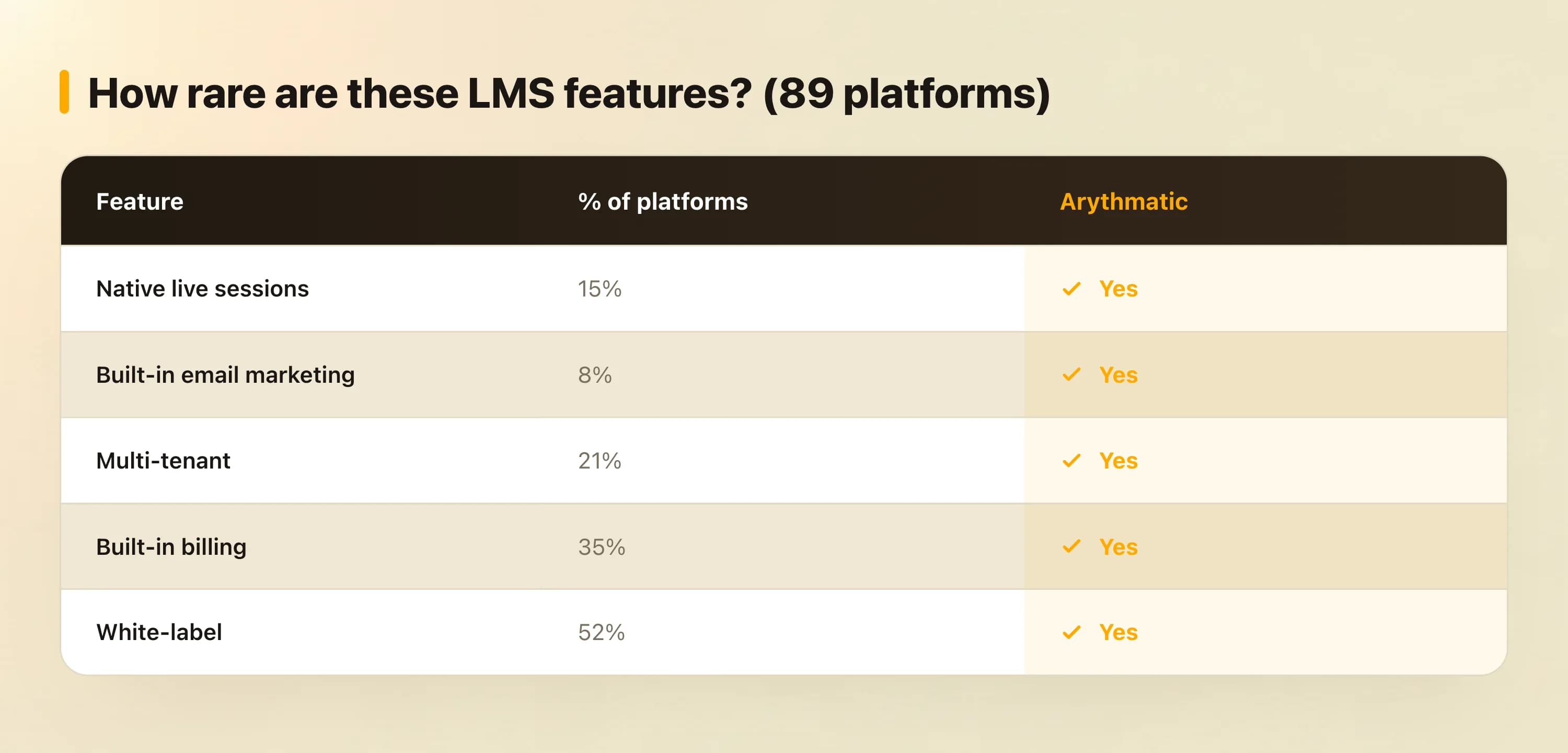
How rare are these LMS features?
Frequently Asked Questions
What LMS is best for K-12 schools?
K-12 schools need an LMS that's simple for teachers, engaging for students, and affordable for districts. Arythmatic offers an intuitive platform with quizzes, live sessions, and progress tracking.
Is Arythmatic suitable for K-12 schools?
Arythmatic provides course creation, assessments, live sessions, and analytics applicable to K-12 education. Contact our team to discuss specific requirements for your school or district.
Does Arythmatic comply with COPPA and FERPA?
Arythmatic implements robust data protection controls. Contact our team for detailed compliance documentation relevant to K-12 student data privacy requirements.
Can parents view student progress?
Arythmatic's reporting features can be configured to provide progress visibility for relevant stakeholders including parents and guardians.
Does Arythmatic work on student Chromebooks?
Yes. Arythmatic is a cloud-based platform accessible from any modern browser, including Chrome on Chromebooks commonly used in K-12 settings.
Can the district manage multiple schools from one dashboard?
Yes. Multi-tenant architecture enables district-level management across multiple schools with centralized content control and school-level administration.
Keep researching
Definitions, alternative platforms, and feature deep-dives relevant to your decision.
Glossary
Learning Management System (LMS)
Glossary
Learning Experience Platform (LXP)
Glossary
SCORM (Sharable Content Object Reference Model)
Glossary
Competency-Based Learning
Buyer guide
Best LMS for Employee Training
Buyer guide
Best LMS for Customer Education & Training
Buyer guide
Best LMS for Compliance Training
Buyer guide
Best LMS Platform for Course Creators
Compare
Thinkific alternatives
Compare
Teachable alternatives
Compare
Kajabi alternatives
Compare
TalentLMS alternatives
Compare
Docebo alternatives
Feature
Course Builder — Create Professional Online Courses
Feature
Live Classes Platform — Host Webinars, Workshops & Virtual Classrooms
Feature
Compliance Training Software — Automate Mandatory Training Programs
Feature
LMS Analytics & Reporting — Data-Driven Learning Insights
Ready to build your academy?
Start your 14-day free trial. No credit card required.