
LMS Buyer's Guide
Best LMS for Selling Courses Online in 2026
Monetize your expertise by selling online courses. Built-in payment processing, pricing flexibility, and marketing tools — zero transaction fees.
Last Updated: September 2026
Selling courses online has become a legitimate business model for educators, experts, and organizations looking to monetize their knowledge. The global e-learning market exceeds $300 billion, with individual course creators and training companies capturing a growing share. But monetizing courses successfully requires more than great content — it requires a platform that handles the entire commerce stack: payment processing, pricing flexibility, tax management, marketing tools, and revenue analytics. Many course creators start on marketplace platforms like Udemy or Skillshare, only to discover that these platforms control pricing, take large revenue cuts, and own the student relationship. Moving to your own platform gives you full control over pricing, branding, and student data — but you need a platform that makes the commerce side as seamless as the learning side. The ideal course commerce platform supports multiple pricing models (one-time, subscription, bundles), integrates with payment processors, provides marketing tools like landing pages and coupon codes, and charges minimal or zero transaction fees so you keep your revenue.
Who Needs This?
Course Creator Entrepreneur
Marketplace platforms take 30-50% of revenue and offer no control over pricing, branding, or student relationships
Own your platform with custom pricing, full branding, and 0% transaction fees — keeping 100% of your revenue
Training Company CFO
Transaction fees on course sales are eating into margins as revenue grows, reducing profitability
Zero transaction fees mean every dollar of course revenue goes to your business, not the platform
Professional Association Director
Need to sell CE courses to members but current tools make the purchase and enrollment process clunky
Seamless course purchase with built-in billing, instant enrollment, and automated certificate delivery
Key Challenges
Payment Processing Complexity
Setting up Stripe, handling taxes, managing refunds, and dealing with multiple currencies shouldn't require a developer.
Pricing Flexibility
You need one-time payments, subscriptions, bundles, coupons, and tiered pricing — not just one model.
High Transaction Fees
Platforms taking 5-10% per sale eat into margins significantly as your revenue grows.
Must-Have Features to Look For
Why Arythmatic Is the Best Choice
Arythmatic is a modern, all-in-one learning infrastructure platform. Here's why it leads the pack:
- 1.0% transaction fees — keep 100% of your revenue
- 2.Built-in payment processing with Stripe
- 3.Support for one-time, subscription, and bundle pricing
- 4.Coupon codes and promotional tools
- 5.Revenue analytics dashboard
Compare Top Platforms
| Platform | Live Sessions | White-Label | SCORM | Community | Pricing |
|---|---|---|---|---|---|
| Arythmatic | ✓ | ✓ | ✓ | ✓ | From $49/mo |
| Thinkific | ✗ | ✗ | ✗ | ✓ | $36–49/mo |
| Teachable | ✗ | ✗ | ✗ | ✗ | $29–39/mo |
| Kajabi | ✗ | ✓ | ✗ | ✓ | $149–399/mo |
| Podia | ✗ | ✗ | ✗ | ✓ | $33–39/mo |
| LearnWorlds | ✗ | ✓ | ✓ | ✓ | $24–29/mo |
| FreshLearn | ✗ | ✗ | ✗ | ✓ | $29–49/mo |
How to Evaluate LMS Platforms for This Use Case
Typical Implementation Timeline
Commerce Setup
Connect Stripe, configure pricing models, create coupon codes, and set up your course storefront.
Course & Marketing Build
Create courses, build marketing landing pages, and configure email sequences for sales and onboarding.
Launch & Promote
Launch your course store, promote to your audience, and monitor sales analytics and conversion rates.
What Does an LMS Cost?
Course selling platforms range from free (with 5-10% transaction fees) to $200-500/month for professional features. On a platform charging 5% transaction fees, $200,000 in annual revenue means $10,000 goes to the platform beyond monthly fees. Arythmatic's 0% transaction fees and flat-rate pricing mean you keep all your revenue regardless of sales volume — a significant advantage as your course business scales.
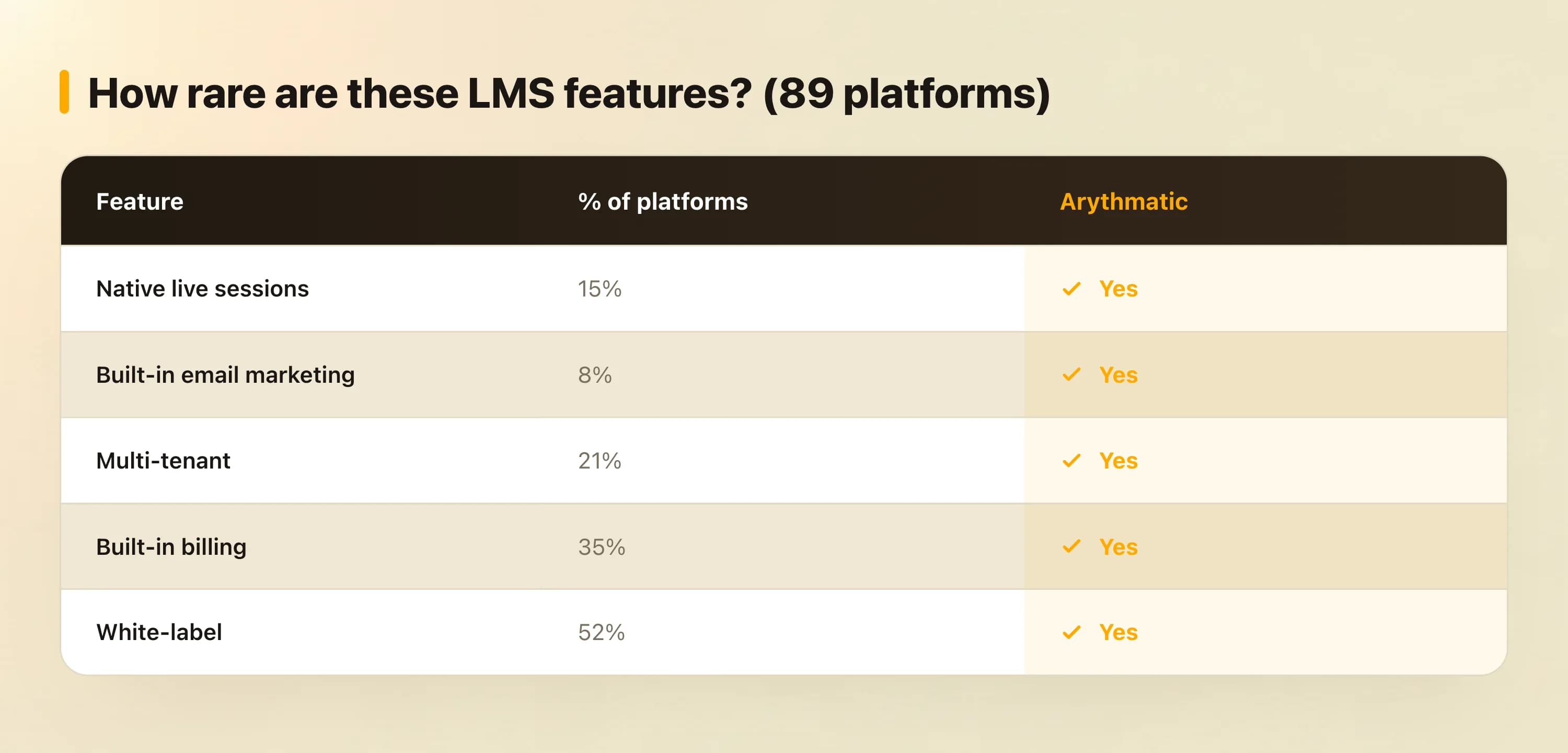
How rare are these LMS features?
Frequently Asked Questions
Which LMS has no transaction fees?
Arythmatic charges 0% transaction fees on all plans. Unlike Teachable (5-10%), Podia (5%), and Thinkific (transaction fees on basic plans), Arythmatic lets you keep all your revenue.
How do I sell courses online?
Create your courses on Arythmatic, set up pricing, connect your Stripe account, and start selling. Built-in marketing tools, landing pages, and email automation help you drive sales.
Which LMS has zero transaction fees?
Arythmatic charges 0% transaction fees on all plans. You keep 100% of your course revenue (minus standard Stripe processing fees).
Can I sell courses with subscriptions and bundles?
Yes. Arythmatic supports one-time payments, subscriptions, and bundle pricing — giving you flexibility in how you monetize your courses.
How do I accept payments from international students?
Arythmatic integrates with Stripe, supporting 135+ currencies and payment methods for global course sales.
Can I create promotional discounts?
Yes. Built-in coupon codes and promotional pricing tools let you run sales, early-bird offers, and exclusive discounts.
Do I need a separate website to sell courses?
No. Arythmatic includes course catalog pages and marketing landing pages, providing everything you need to sell courses without a separate website.
Keep researching
Definitions, alternative platforms, and feature deep-dives relevant to your decision.
Glossary
Learning Management System (LMS)
Glossary
Learning Experience Platform (LXP)
Glossary
SCORM (Sharable Content Object Reference Model)
Glossary
Competency-Based Learning
Buyer guide
Best LMS for Employee Training
Buyer guide
Best LMS for Customer Education & Training
Buyer guide
Best LMS for Compliance Training
Buyer guide
Best LMS Platform for Course Creators
Compare
Thinkific alternatives
Compare
Teachable alternatives
Compare
Kajabi alternatives
Compare
TalentLMS alternatives
Compare
Docebo alternatives
Feature
Course Builder — Create Professional Online Courses
Feature
Live Classes Platform — Host Webinars, Workshops & Virtual Classrooms
Feature
Compliance Training Software — Automate Mandatory Training Programs
Feature
LMS Analytics & Reporting — Data-Driven Learning Insights
Ready to build your academy?
Start your 14-day free trial. No credit card required.