
LMS Buyer's Guide
Best LMS for Upskilling & Reskilling in 2026
Close skills gaps with structured upskilling and reskilling programs. Track competency development and build career learning paths.
Last Updated: September 2026
The half-life of professional skills is shrinking rapidly — what was cutting-edge knowledge five years ago may be obsolete today. Organizations that fail to continuously upskill their workforce risk falling behind competitors, losing top talent to companies that invest in development, and finding themselves unable to execute on strategic initiatives because they lack the internal capabilities. Reskilling takes this a step further, helping employees transition into entirely new roles as business needs evolve. The World Economic Forum estimates that 50% of all employees will need reskilling by 2025, and companies that invest in internal mobility through reskilling programs save significantly compared to external hiring. A modern upskilling and reskilling LMS provides the infrastructure for continuous learning programs: skills assessments to identify gaps, learning paths that build new competencies progressively, certifications that validate new skills, and analytics that track workforce capability over time. The most effective programs combine self-paced courses with mentoring, live workshops, and hands-on projects — all managed within a unified platform that gives L&D leaders visibility into organizational skill development.
Who Needs This?
Chief People Officer
Cannot fill critical roles internally because employees lack emerging skills, forcing expensive external hires
Structured upskilling paths develop internal talent into new roles, reducing recruitment costs and improving retention
L&D Program Manager
Skills gaps are identified but there is no systematic way to close them with measurable learning programs
Skills-based learning paths with progressive certifications create measurable, trackable skill development programs
Digital Transformation Lead
Technology adoption is stalling because the workforce lacks the digital skills to use new tools effectively
Digital skills training programs with hands-on assessments ensure employees can actually apply new technical competencies
Key Challenges
Identifying Skills Gaps
Without assessment data, organizations don't know which skills are missing or where to focus training investment.
Personalized Learning at Scale
Different employees need different learning paths based on their current skills and target roles.
Measuring Skill Development
Tracking competency progression over time requires pre/post assessments and ongoing measurement.
Must-Have Features to Look For
Why Arythmatic Is the Best Choice
Arythmatic is a modern, all-in-one learning infrastructure platform. Here's why it leads the pack:
- 1.Structured learning paths mapped to skill competencies
- 2.Built-in assessments for measuring skill acquisition
- 3.Progress dashboards for managers and learners
- 4.Certificate generation for completed competency milestones
- 5.Native live sessions for skills coaching and mentoring
Compare Top Platforms
| Platform | Live Sessions | White-Label | SCORM | Community | Pricing |
|---|---|---|---|---|---|
| Arythmatic | ✓ | ✓ | ✓ | ✓ | From $49/mo |
| Thinkific | ✗ | ✗ | ✗ | ✓ | $36–49/mo |
| Teachable | ✗ | ✗ | ✗ | ✗ | $29–39/mo |
| Kajabi | ✗ | ✓ | ✗ | ✓ | $149–399/mo |
| Podia | ✗ | ✗ | ✗ | ✓ | $33–39/mo |
| LearnWorlds | ✗ | ✓ | ✓ | ✓ | $24–29/mo |
| FreshLearn | ✗ | ✗ | ✗ | ✓ | $29–49/mo |
How to Evaluate LMS Platforms for This Use Case
Typical Implementation Timeline
Skills Mapping
Identify critical skill gaps, define target competencies, and design learning paths for priority upskilling areas.
Program Build
Create skill-building courses, configure assessments, and establish certification milestones for each learning path.
Pilot Program
Launch with a pilot group, track skill development metrics, and refine content based on learner feedback and outcomes.
Organization-Wide Rollout
Expand to all priority groups, integrate with career development programs, and establish ongoing skills development cadence.
What Does an LMS Cost?
Upskilling platforms range widely from $5-50 per user per month for content-focused platforms to $100,000+ annually for enterprise talent development suites. The total investment includes platform costs, content development or licensing, and program management time. Arythmatic's flat-rate pricing provides the platform infrastructure for upskilling programs at a predictable cost, while its course builder enables internal content development without additional authoring tool subscriptions.
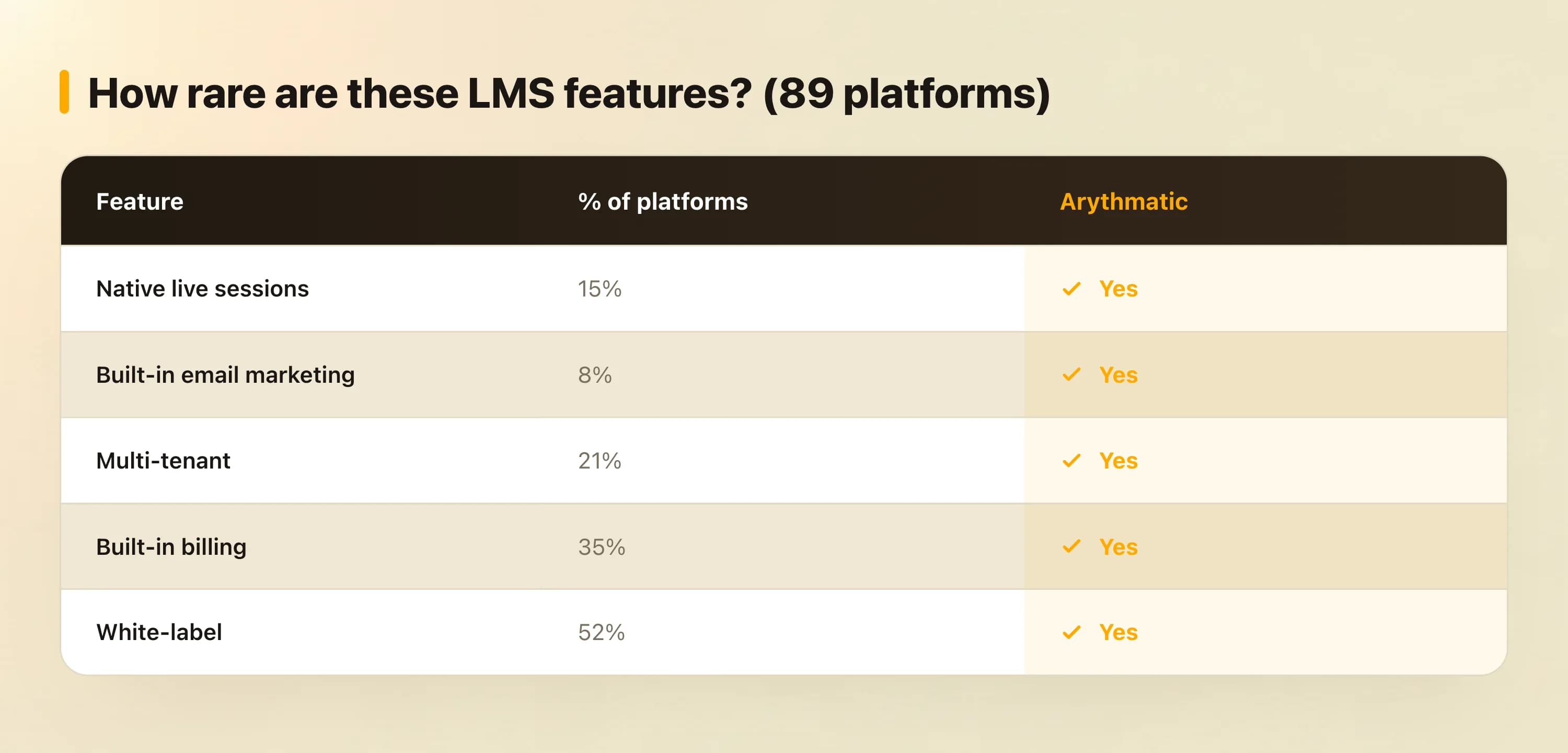
How rare are these LMS features?
Frequently Asked Questions
What is skill-based training?
Skill-based training focuses on developing specific competencies through targeted learning modules and assessments. Arythmatic's learning paths and assessment engine make it easy to build and track skill development programs.
How do companies upskill employees with an LMS?
Companies use an LMS like Arythmatic to create role-based learning paths, assess baseline skills, deliver targeted training, and measure competency improvement over time.
What is the difference between upskilling and reskilling?
Upskilling develops deeper expertise in an employee's current role, while reskilling trains employees for entirely new roles. Arythmatic supports both with flexible learning paths and certification programs.
How do I identify which skills to develop?
Start with your strategic priorities, then assess current workforce capabilities against those needs. Arythmatic's assessment tools help identify gaps and track development progress.
How long do upskilling programs typically take?
Most upskilling programs run 3-6 months with ongoing reinforcement. Reskilling into new roles typically takes 6-12 months of structured learning.
Can managers track their team's skill development?
Yes. Arythmatic provides manager dashboards showing team progress, certification status, and skills development over time.
Does upskilling improve employee retention?
Yes. Companies with strong learning cultures see 30-50% higher retention rates. Employees who see career development investment are far more likely to stay.
Keep researching
Definitions, alternative platforms, and feature deep-dives relevant to your decision.
Glossary
Learning Management System (LMS)
Glossary
Learning Experience Platform (LXP)
Glossary
SCORM (Sharable Content Object Reference Model)
Glossary
Competency-Based Learning
Buyer guide
Best LMS for Employee Training
Buyer guide
Best LMS for Customer Education & Training
Buyer guide
Best LMS for Compliance Training
Buyer guide
Best LMS Platform for Course Creators
Compare
Thinkific alternatives
Compare
Teachable alternatives
Compare
Kajabi alternatives
Compare
TalentLMS alternatives
Compare
Docebo alternatives
Feature
Course Builder — Create Professional Online Courses
Feature
Live Classes Platform — Host Webinars, Workshops & Virtual Classrooms
Feature
Compliance Training Software — Automate Mandatory Training Programs
Feature
LMS Analytics & Reporting — Data-Driven Learning Insights
Ready to build your academy?
Start your 14-day free trial. No credit card required.